> ## Documentation Index
> Fetch the complete documentation index at: https://docs.textql.com/llms.txt
> Use this file to discover all available pages before exploring further.
# Model Management
> Configure which AI models are available in your organization, set defaults, and control per-role access
TextQL supports a range of AI models from Anthropic, OpenAI, and other providers. Organization administrators can control which models are available, set defaults, and decide whether users can switch models themselves.
Model settings are found under **Settings → Models**, which has three tabs: **Model Catalog**, **Role Access**, and **Analytics**.
***
## Available Models
TextQL's model catalog includes models across several providers:
### Anthropic (Claude)
| Model | Best For | Context Window |
| - | - | - |
| Claude Fable 5.1 | Anthropic's most capable widely released model. Demanding reasoning and long-horizon agentic work. Requires the "Allow LLM Data Retention" security setting to be enabled, not available under zero data retention. | 1M\* |
| Claude Fable 5 | Previous Fable release. Demanding reasoning and long-horizon agentic work. Requires the "Allow LLM Data Retention" security setting to be enabled — not available under zero data retention. | 1M\* |
| Claude Opus 5.5 | Latest Opus. Complex agentic coding, deep reasoning, and long-horizon enterprise work. Thinking is always on and cannot be disabled. Lower cost than Opus 5. Supports [Fast Mode](/core/admin/pricing#inference) (2× ACU cost). | 1M\* |
| Claude Opus 5 | Previous Opus release. Complex agentic coding, deep reasoning, and long-horizon enterprise work. Higher cost than Sonnet. Supports [Fast Mode](/core/admin/pricing#inference) (2× ACU cost). | 1M\* |
| Claude Opus 4.8 | Most capable Anthropic model. Complex analysis, advanced reasoning, demanding agentic tasks. Higher cost than Sonnet. Supports [Fast Mode](/core/admin/pricing#inference) (2× ACU cost). | 1M\* |
| Claude Opus 4.7 | Complex analysis, advanced reasoning, demanding agentic tasks. Higher cost than Sonnet. | 1M\* |
| Claude Sonnet 5.5 | Latest Sonnet. Near Opus 4.8 quality for most tasks without the Opus cost. Adaptive thinking is always on and cannot be disabled. On Amazon Bedrock, available only when global cross-region inference is enabled. | 1M\* |
| Claude Sonnet 5 | Previous Sonnet release. Near Opus 4.8 quality for most tasks, SQL generation, dashboards, agentic workflows, at a fraction of the cost. | 1M\* |
| Claude Sonnet 4.6 | Most tasks — SQL generation, dashboards, agentic workflows. | 1M\* |
| Claude Haiku 4.5 | Simple Q\&A and quick lookups. Fastest and lowest cost. | 200K |
\* 1M token context window available in beta. Standard pricing applies up to 200K input tokens; tokens beyond 200K are billed at a higher rate. See [Pricing](/core/admin/pricing#inference) for details.
### OpenAI (GPT)
| Model | Best For | Context Window |
| - | - | - |
| GPT-6 Astra | OpenAI's newest flagship. Successor to GPT-5.6 Sol for the most demanding reasoning and agentic work. | 1.05M |
| GPT-6.1 Sol | OpenAI's newest Sol. An upgrade over GPT-6 Sol at the same price, with cheaper cached input. | 1.05M |
| GPT-6 Sol | Balanced GPT-6 model for coding, reasoning, and agentic workflows. | 1.05M |
| GPT-6 Luna | Efficient model for focused, high-volume tasks. | 1.05M |
| GPT-5.6 Sol | Advanced coding, research, and the most demanding agentic workflows. | 1M |
| GPT-5.6 Terra | GPT-5.5-level performance at roughly half the cost. Good OpenAI default for most tasks. | 1M |
| GPT-5.6 Luna | High-throughput, routine tasks. Fastest and most cost-efficient GPT-5.6 tier. | 1M |
| GPT-5.5 | Deprecated, retires November 2, 2026 (moves to GPT-6 Sol). Complex reasoning, dashboards, and agentic workflows. | 1M\* |
| GPT-5.4 | Deprecated, retires November 2, 2026 (moves to GPT-6 Sol). Complex reasoning, dashboards, data analysis. | 1M\* |
| GPT-5.4 Mini | Deprecated, retires November 2, 2026 (moves to GPT-6 Luna). Simple, well-defined tasks. | 1M\* |
### Google (Gemini)
| Model | Best For | Context Window |
| - | - | - |
| Gemini 3.1 Pro | Google's most advanced reasoning model. Complex reasoning and agentic workflows. | 1M\* |
| Gemini 3.8 Flash | Google's newest Flash model. Frontier coding and agentic performance at Flash latency and cost. Currently on introductory pricing through Dec 31, 2026. | 1M |
| Gemini 3.5 Flash | Frontier coding and agentic performance at Flash latency and cost. | 1M\* |
### Meta
| Model | Best For | Context Window |
| - | - | - |
| Muse Spark 1.1 | Meta's first frontier model. Tool use and multi-step work with always-on reasoning. US-only preview. | 1M |
### DeepSeek (via Fireworks)
| Model | Best For | Context Window |
| - | - | - |
| DeepSeek V4.1 Flash | DeepSeek's newest reasoning model with image input and tool calling, for fast and very low-cost high-throughput work. | 1M |
| DeepSeek V4 Flash 0731 | DeepSeek's fast, very low-cost model. Good for high-throughput and routine analytical tasks. | 1M |
| DeepSeek V4 Flash Vision Exp | DeepSeek's low-cost V4 Flash with image input. Good for reading charts, screenshots, and scanned documents. | 1M |
### Moonshot (via Fireworks)
| Model | Best For | Context Window |
| - | - | - |
| Kimi K2.7 | Kimi frontier model. Long-horizon coding, agentic execution, long-context reasoning. | 256K |
| Kimi K3 | Latest Kimi frontier model. Multimodal; repository-scale coding, debugging, long-horizon agentic work. | 1M |
### Zhipu / GLM (via Fireworks)
| Model | Best For | Context Window |
| - | - | - |
| GLM 5.3 | Frontier GLM reasoning model. Complex agentic workflows and long-context analysis. | 1M |
| GLM 5.3 Flash | Fast, cost-efficient multimodal analysis and high-throughput agentic work. | 1M |
| GLM 5.2 | Frontier GLM model. Complex reasoning and very-long-document analysis. | 1M |
### Qwen (via Fireworks)
| Model | Best For | Context Window |
| - | - | - |
| Qwen3.7 Plus | Cost-effective coding and general analytical tasks with a large context window. | 256K |
For ACU pricing on each model, see the [Pricing page](/core/admin/pricing#inference).
***
## Model Catalog
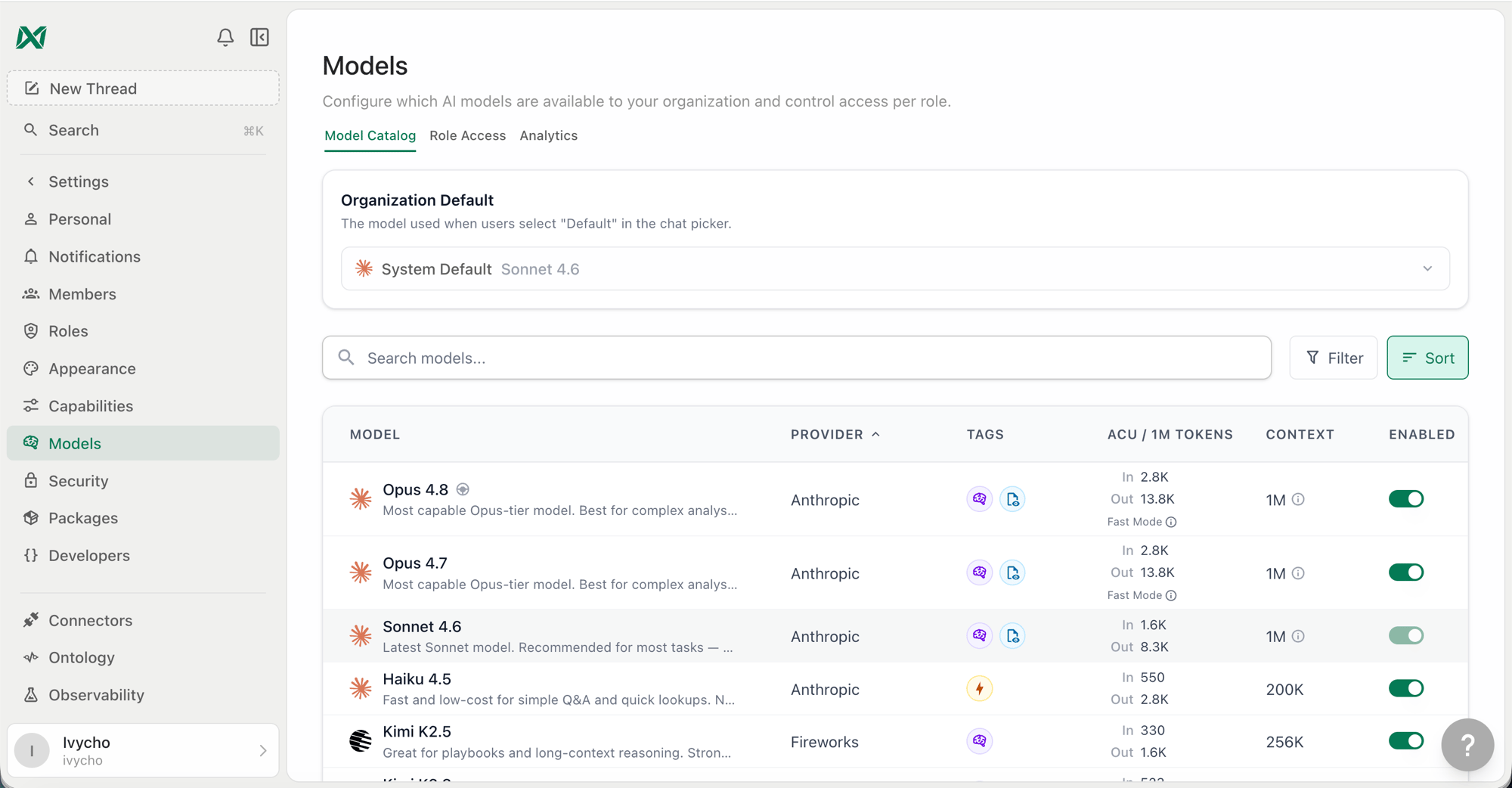
The **Model Catalog** tab is where administrators enable or disable models for the organization and set the organization-wide default.
 ### Enabling and Disabling Models
By default, all models in the catalog are available to your organization. You can disable any model to prevent it from appearing in the model picker for all users.
A disabled model cannot be selected by any user regardless of their role settings. If a role has a disabled model set as its default, the system default takes over.
### Setting the Organization Default
The organization default is the model Ana uses when no specific model has been selected for a conversation. It appears as **"Org Default"** in role settings and is distinct from the **System Default**.
* **System Default** — TextQL's platform-level default, currently Claude Sonnet 5 for Anthropic organizations and GPT-5.6 Sol for OpenAI organizations. This automatically updates as the platform evolves.
* **Org Default** — An explicit model your organization has pinned. Overrides the System Default for all roles that inherit from the org.
If no org default is set, all roles fall back to the System Default.
***
## Role Access
The **Role Access** tab gives fine-grained control over which models each role can use, what their default is, and whether users in that role can switch models mid-conversation.
### Enabling and Disabling Models
By default, all models in the catalog are available to your organization. You can disable any model to prevent it from appearing in the model picker for all users.
A disabled model cannot be selected by any user regardless of their role settings. If a role has a disabled model set as its default, the system default takes over.
### Setting the Organization Default
The organization default is the model Ana uses when no specific model has been selected for a conversation. It appears as **"Org Default"** in role settings and is distinct from the **System Default**.
* **System Default** — TextQL's platform-level default, currently Claude Sonnet 5 for Anthropic organizations and GPT-5.6 Sol for OpenAI organizations. This automatically updates as the platform evolves.
* **Org Default** — An explicit model your organization has pinned. Overrides the System Default for all roles that inherit from the org.
If no org default is set, all roles fall back to the System Default.
***
## Role Access
The **Role Access** tab gives fine-grained control over which models each role can use, what their default is, and whether users in that role can switch models mid-conversation.
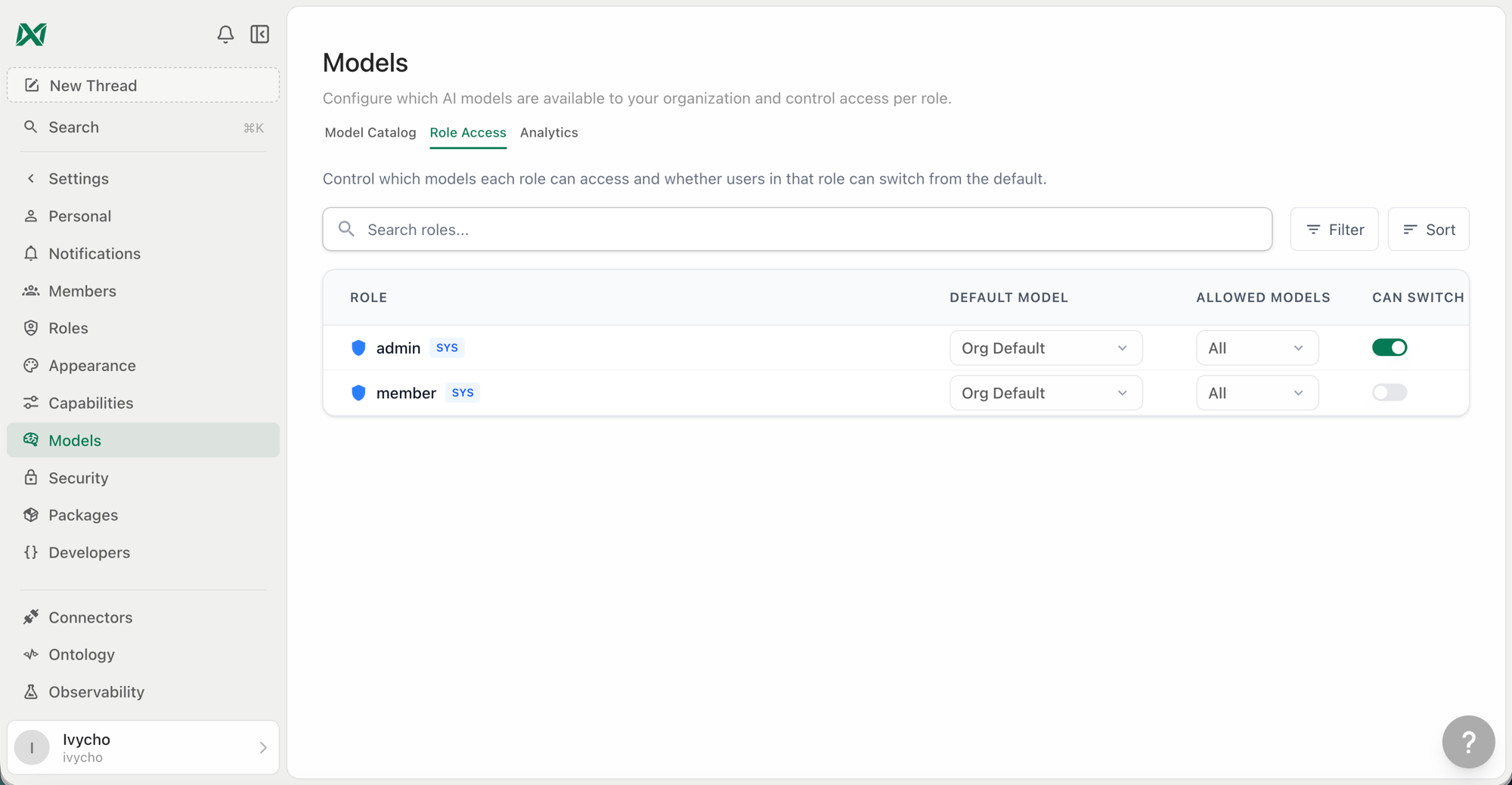 Each role has three configurable settings:
### Default Model
The model Ana starts a new conversation with for users in this role. Options are:
* **Org Default** — Inherits whatever the organization default is set to (recommended for most roles)
* **System Default** — Pins to TextQL's platform default, auto-updating with the platform
* **Specific model** — Pins to an explicit model regardless of org or system defaults
### Allowed Models
The subset of org-enabled models that users in this role can see in the model picker. Defaults to all enabled models. Restricting this is useful if you want certain roles to only access lower-cost or specific provider models.
> **Note:** A role's default model is always included in its allowed list. You cannot remove a model from the allowed list if it is set as that role's default — change the role default first.
When the organization has an explicit default model, every role that keeps **Org Default** can use it even if it is not checked in the role's allowed list, so changing the org default reaches those roles without editing each list. If the organization follows the System Default instead, the role's allowed list still applies and users start on the first allowed model when the platform default is not in it.
When a user holds several roles, the most permissive role wins: the user can switch models if any role allows it, and can use any model that any of their roles allows. A role with all models allowed grants access to every enabled model regardless of the other roles' restrictions.
### Can Switch
Controls whether users in this role see the model picker in the chat interface at all. When disabled, users in this role cannot change the model — they always use the role's default.
| Can Switch | Behavior |
| - | - |
| On | Users see the model picker and can choose any model in their allowed list |
| Off | Model picker is hidden; the role's default model is used silently |
### Configuring via API
These three settings are fields on the role, set from this tab or programmatically with the role update API (`RBACService/UpdateRole`). They are **not** [RBAC permissions](/core/admin/rbac) and cannot be granted through a role's permission list — `allow_model_switching` is a UI label, not a permission string.
| UI setting | Role field |
| - | - |
| Can Switch | `allow_model_choice` |
| Default Model | `default_model_id` |
| Allowed Models | `allowed_model_ids` |
`default_model_id` and `allowed_model_ids` take `LlmModel` enum numbers. An empty `allowed_model_ids` is treated as "no change"; send `clear_allowed_model_ids: true` to reset it back to all models.
***
## Model Picker (User-Facing)
When model switching is enabled for a role, users see a model picker in the top right of the chat interface. It shows:
* **Default** — The system/org/role default, auto-updating with the platform
* All models the role is allowed to access, grouped with provider icons
Hovering over a model for \~1 second expands its description. The currently selected model is highlighted with a checkmark. Models approaching deprecation show a warning icon with the deprecation date.
Each role has three configurable settings:
### Default Model
The model Ana starts a new conversation with for users in this role. Options are:
* **Org Default** — Inherits whatever the organization default is set to (recommended for most roles)
* **System Default** — Pins to TextQL's platform default, auto-updating with the platform
* **Specific model** — Pins to an explicit model regardless of org or system defaults
### Allowed Models
The subset of org-enabled models that users in this role can see in the model picker. Defaults to all enabled models. Restricting this is useful if you want certain roles to only access lower-cost or specific provider models.
> **Note:** A role's default model is always included in its allowed list. You cannot remove a model from the allowed list if it is set as that role's default — change the role default first.
When the organization has an explicit default model, every role that keeps **Org Default** can use it even if it is not checked in the role's allowed list, so changing the org default reaches those roles without editing each list. If the organization follows the System Default instead, the role's allowed list still applies and users start on the first allowed model when the platform default is not in it.
When a user holds several roles, the most permissive role wins: the user can switch models if any role allows it, and can use any model that any of their roles allows. A role with all models allowed grants access to every enabled model regardless of the other roles' restrictions.
### Can Switch
Controls whether users in this role see the model picker in the chat interface at all. When disabled, users in this role cannot change the model — they always use the role's default.
| Can Switch | Behavior |
| - | - |
| On | Users see the model picker and can choose any model in their allowed list |
| Off | Model picker is hidden; the role's default model is used silently |
### Configuring via API
These three settings are fields on the role, set from this tab or programmatically with the role update API (`RBACService/UpdateRole`). They are **not** [RBAC permissions](/core/admin/rbac) and cannot be granted through a role's permission list — `allow_model_switching` is a UI label, not a permission string.
| UI setting | Role field |
| - | - |
| Can Switch | `allow_model_choice` |
| Default Model | `default_model_id` |
| Allowed Models | `allowed_model_ids` |
`default_model_id` and `allowed_model_ids` take `LlmModel` enum numbers. An empty `allowed_model_ids` is treated as "no change"; send `clear_allowed_model_ids: true` to reset it back to all models.
***
## Model Picker (User-Facing)
When model switching is enabled for a role, users see a model picker in the top right of the chat interface. It shows:
* **Default** — The system/org/role default, auto-updating with the platform
* All models the role is allowed to access, grouped with provider icons
Hovering over a model for \~1 second expands its description. The currently selected model is highlighted with a checkmark. Models approaching deprecation show a warning icon with the deprecation date.
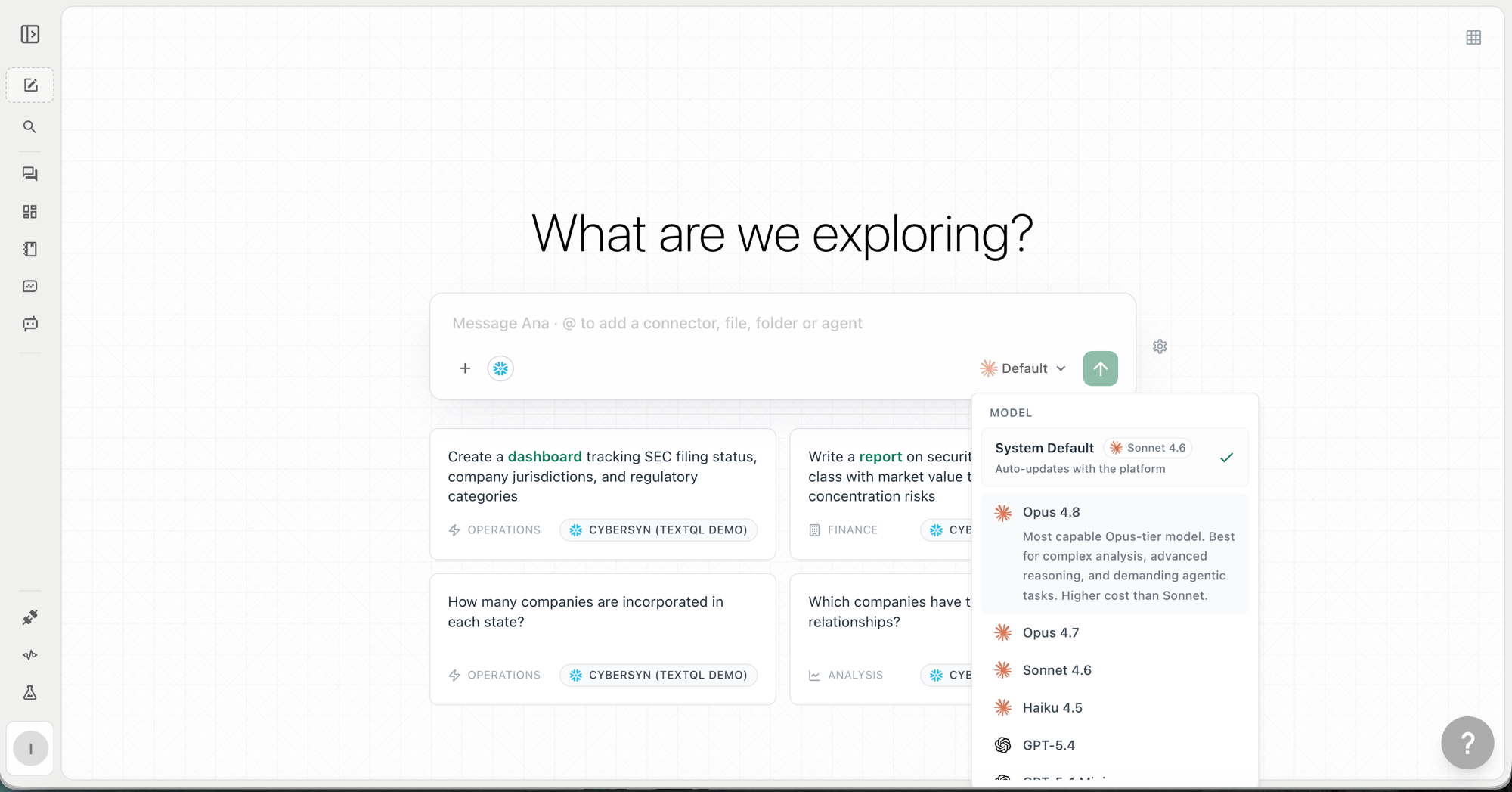 A model selection is scoped to that conversation — switching models in one chat does not affect other chats.
***
## Model Deprecations
When a model is scheduled for deprecation, a warning appears in the model picker next to that model's name, showing the deprecation date. Administrators should update any role defaults that point to a deprecating model before the deprecation date to avoid disruption.
After deprecation, requests to a deprecated model are automatically routed to the nearest equivalent current model.
***
## Frequently Asked Questions
**Can different roles use different providers (Anthropic vs OpenAI)?**
Yes. You can configure one role to default to Claude Sonnet and another to GPT-5.2 by setting explicit role defaults and restricting allowed models per role.
**What happens if a user's role default model is disabled at the org level?**
The system falls back to the org default, then the system default. Disabled models are never served to users even if a role still references them.
**Does model selection affect Playbooks?**
Playbooks use the organization's default model unless a specific model has been configured for that playbook. Role-level model restrictions do not apply to Playbook runs.
**Can I restrict users to only Anthropic models?**
Yes — set the allowed models for a role to only include Claude models. Users in that role will not see OpenAI or other provider options in the picker.
This documentation is built and hosted on [Mintlify](https://mintlify.com), a developer documentation platform.
A model selection is scoped to that conversation — switching models in one chat does not affect other chats.
***
## Model Deprecations
When a model is scheduled for deprecation, a warning appears in the model picker next to that model's name, showing the deprecation date. Administrators should update any role defaults that point to a deprecating model before the deprecation date to avoid disruption.
After deprecation, requests to a deprecated model are automatically routed to the nearest equivalent current model.
***
## Frequently Asked Questions
**Can different roles use different providers (Anthropic vs OpenAI)?**
Yes. You can configure one role to default to Claude Sonnet and another to GPT-5.2 by setting explicit role defaults and restricting allowed models per role.
**What happens if a user's role default model is disabled at the org level?**
The system falls back to the org default, then the system default. Disabled models are never served to users even if a role still references them.
**Does model selection affect Playbooks?**
Playbooks use the organization's default model unless a specific model has been configured for that playbook. Role-level model restrictions do not apply to Playbook runs.
**Can I restrict users to only Anthropic models?**
Yes — set the allowed models for a role to only include Claude models. Users in that role will not see OpenAI or other provider options in the picker.
This documentation is built and hosted on [Mintlify](https://mintlify.com), a developer documentation platform.